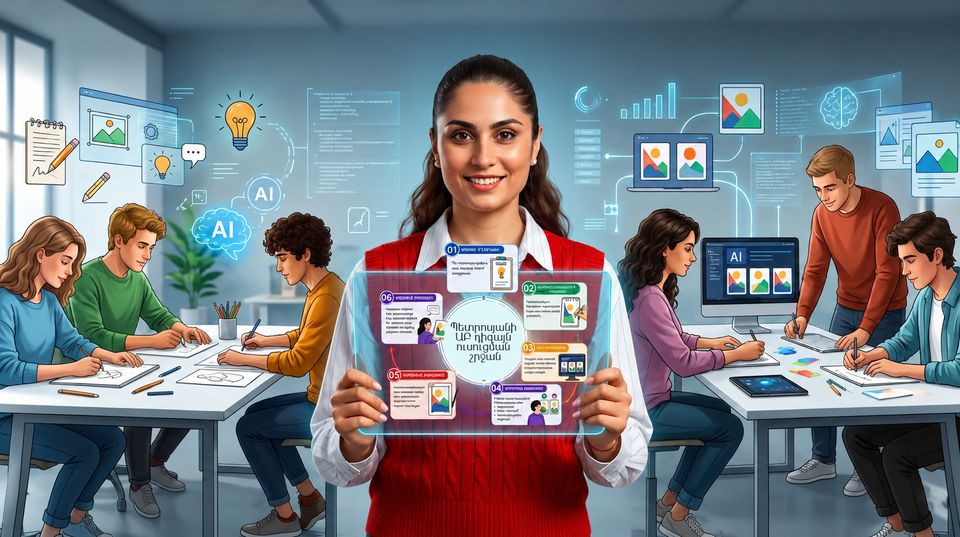
Artificial Intelligence and Creative Education in Design
An Innovative Educational Model for Human–AI Collaboration

About collaboration projects
Collaboration projects require tangible needs (equipment, clothing, computers, etc.) as well as the support of people through their knowledge, experience, and/or connections to solve a specific problem.
Collaboration Needs
Educational institutions
We are seeking collaboration with universities, educational centers, and AI specialists.
Educational institutions
Collaboration includes pilot implementation, lectures, workshops, and research.
SHORT DESCRIPTION
Artificial intelligence is rapidly transforming creative education; however, many students today are beginning to lose their sense of authorship and creative identity. “Petrosyan’s AI Design Learning Cycle” is an innovative educational method in design education that teaches how to use AI consciously, critically, and in a human-centered way, without replacing creativity.
By supporting this project, you contribute to the future of education, the development of young people’s thinking, and the formation of a responsible AI culture.
IMPACT
The project aims to develop, within the next 1–2 years, an applicable educational model that can be integrated into various programs of design, art, and creative education.
The method helps students to:
- develop creative and critical thinking
- preserve their authorship identity while using AI
- learn responsible and effective use of AI
- create not superficial outputs, but conscious and analytical projects
The method has already been tested in teaching and research contexts and has received positive feedback from students.
Join the development of educational innovation in Armenia.
PROBLEM
Today, AI tools are widely used in education and design, but there is still a lack of methodologies that teach how to work with AI without losing one’s own thinking.
Many students become dependent on ready-made AI-generated outputs. The creative process becomes faster but more superficial, while critical thinking becomes weaker.
If new educational approaches are not developed today, we may face a future where professionals master tools but lack their own creative language, conceptual depth, and analytical thinking.
This is not only a technological challenge, but also an educational and cultural one.
SOLUTION
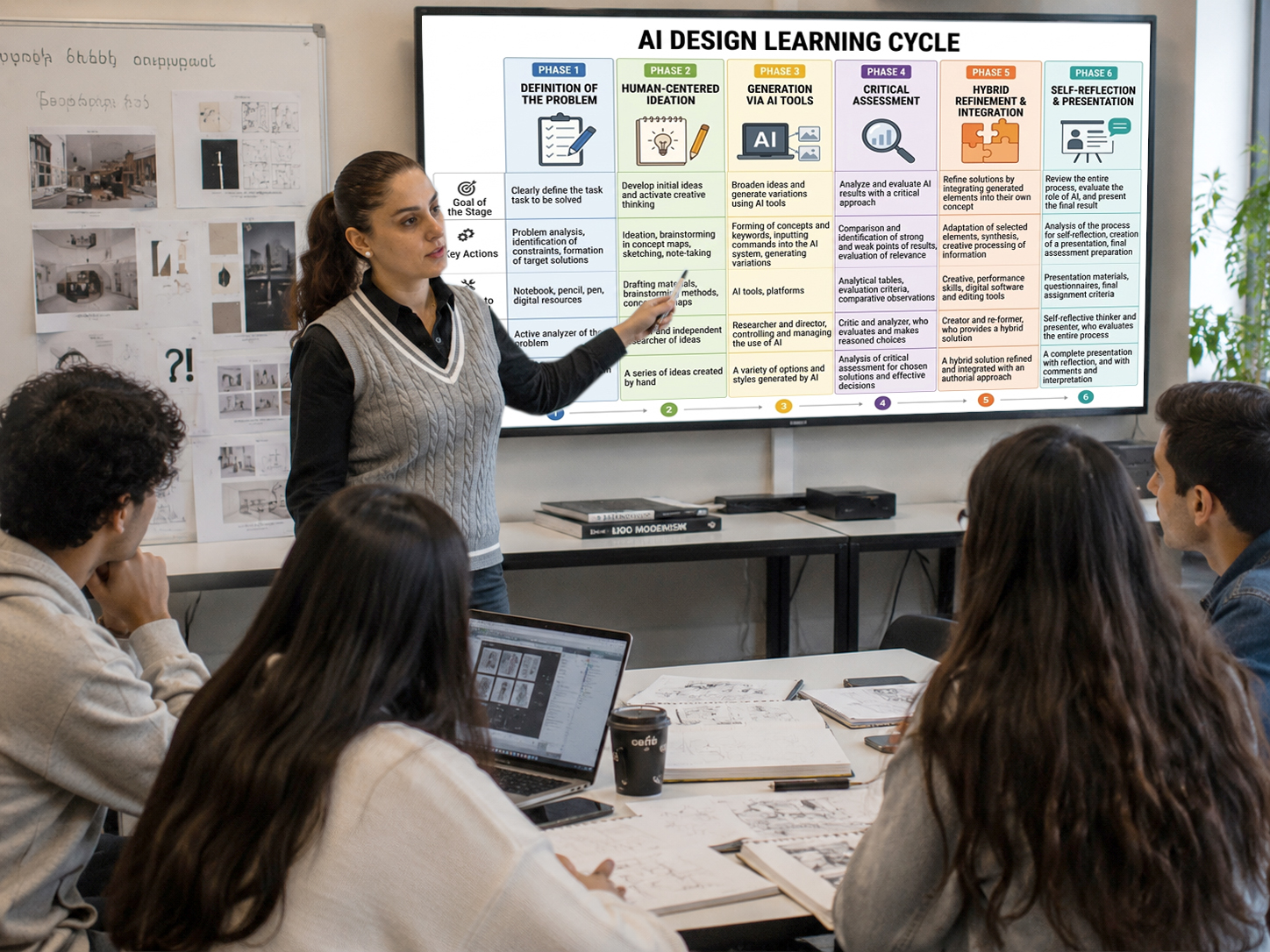
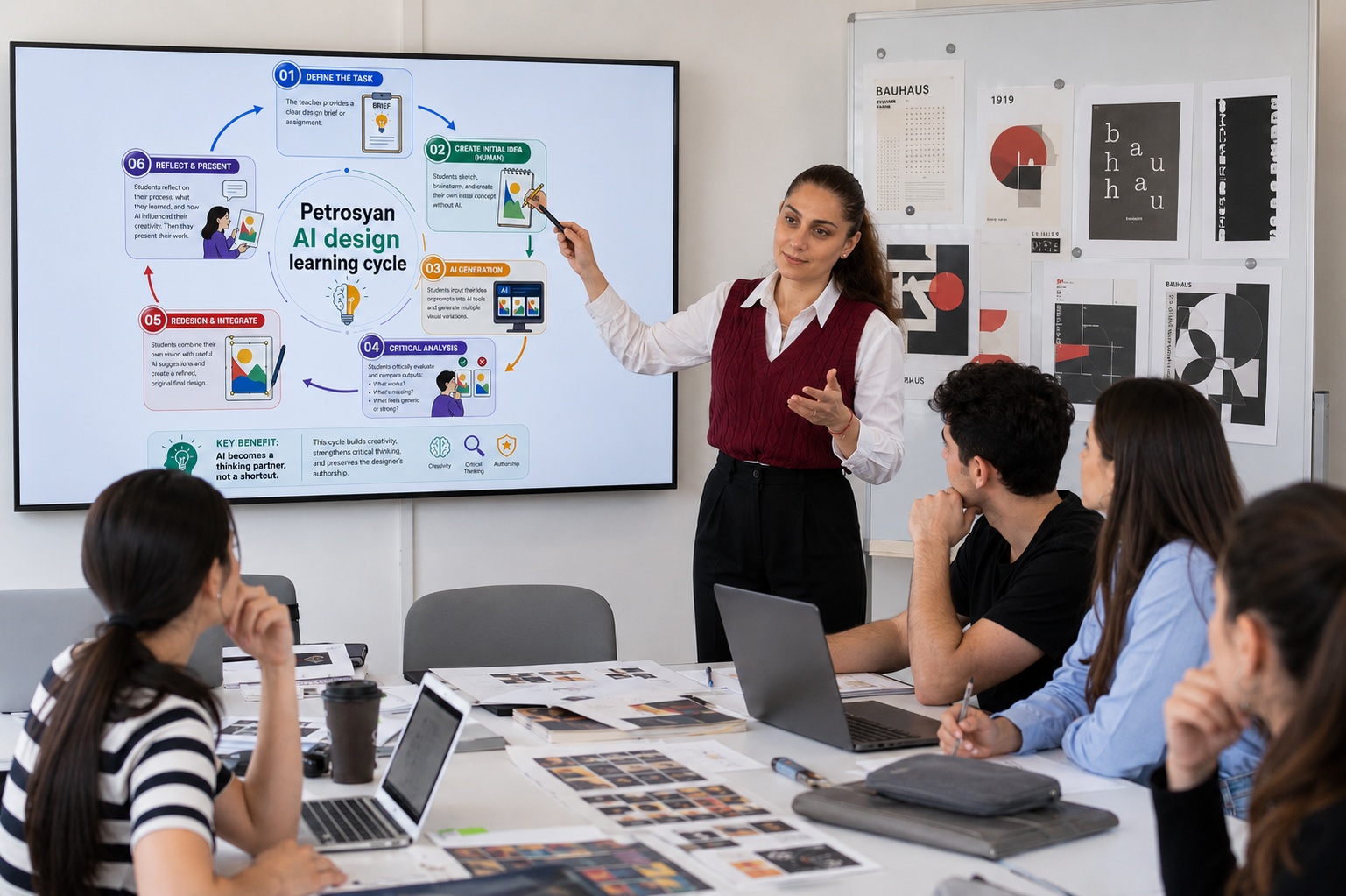
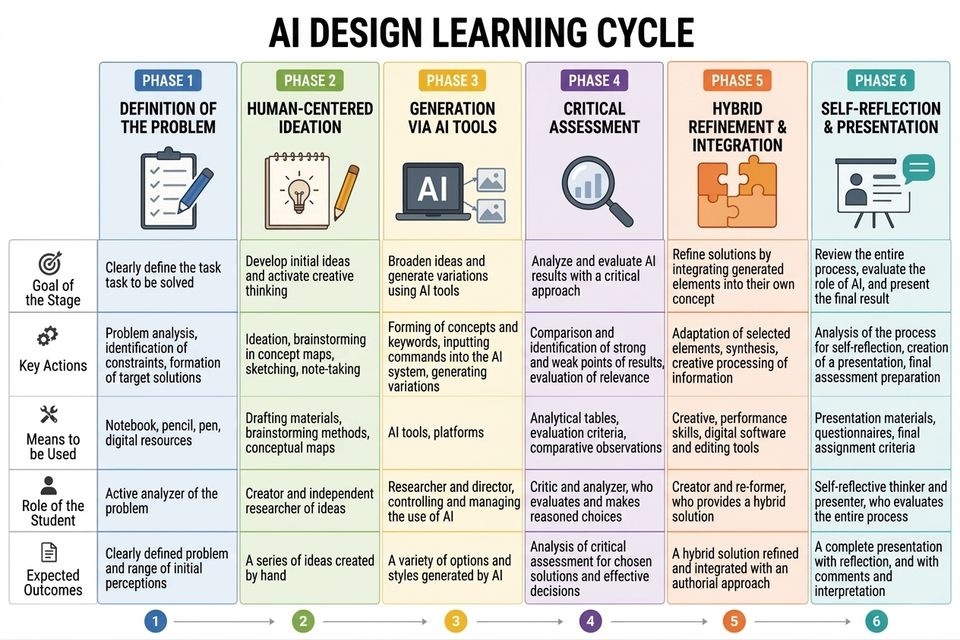
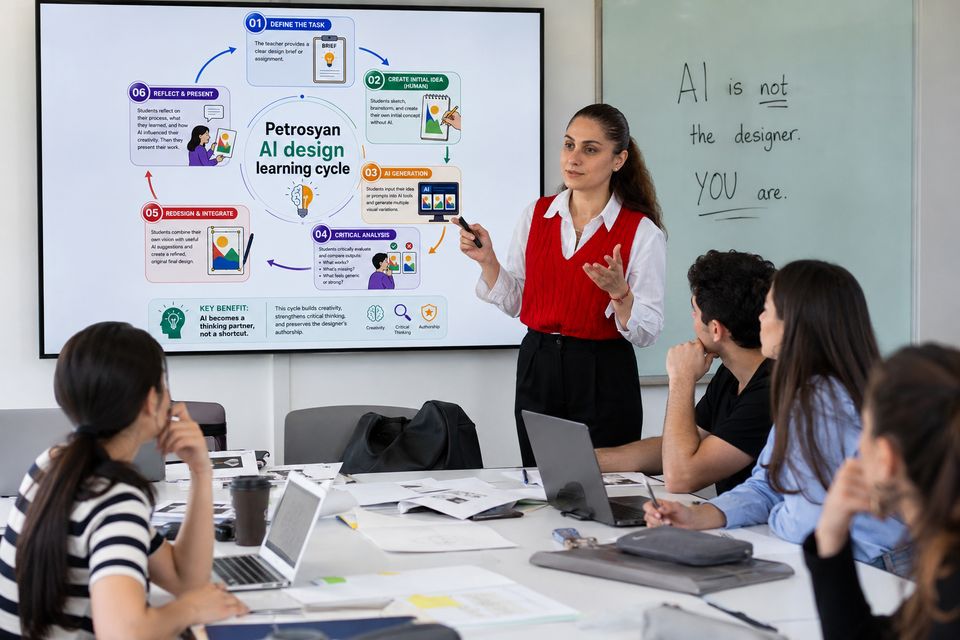
“Petrosyan’s AI Design Learning Cycle” is a phased educational model that combines human creative thinking with the capabilities of artificial intelligence.
The method consists of six interconnected phases:
- Problem definition
- Human ideation
- Controlled AI integration
- Critical analysis
- Refinement and integration
- Reflective evaluation and presentation
Within the project, it is planned to:
- develop a full educational methodology
- create teaching and visual materials
- conduct pilot courses
- produce digital content
- establish a public and professional educational platform
The core idea of the method is that the human leads the creative process, while AI becomes a supportive tool that enhances thinking.
Support human-centered education development.
TEAM
The project is authored by Lusine Petrosyan, a designer, lecturer, and researcher working on the intersection of art, design education, and artificial intelligence.
The project was developed through long-term educational, research, and practical experience. It is based on real teaching practice and aims to create a modern, applicable educational methodology aligned with international developments.
A collaborative professional team is also planned, involving experts from education, design, media, and technology fields.
COLLABORATION
The project is based on educational, professional, and collaborative work and does not require large-scale material resources. The main goal is the dissemination of the method, formation of professional collaborations, and its implementation in educational environments.
At this stage, the following are important:
- collaboration with design and art education institutions
- pilot implementation in universities
- involvement of professional communities
- organization of public and academic discussions
- dissemination and visibility of the methodology
The project is open to educational, scientific, and professional collaboration and aims to build a human-centered AI education community.
Every form of support contributes to the development of a new culture of creative education in Armenia.
FREQUENTLY ASKED QUESTIONS
Is the method intended only for designers?
No. It can be applied across various creative, educational, and interdisciplinary fields.
Will AI replace the student?
No. The core of the method is human-centered creativity, where AI is used as a supportive and conscious tool.
Has the project already been tested?
Yes. The method has been developed and tested through real teaching and educational practice.
How can I support the project?
You can support it by:
- sharing the initiative
- proposing educational or professional collaboration
- inviting presentations, lectures, or workshops
- helping integrate the method into educational settings
CALL TO ACTION
Today we have the opportunity to create a new model of design education where technology does not replace humans, but develops their creative potential.
Join this initiative and support the development of responsible and human-centered AI design education in Armenia.
CONTACTS
lus8990@gmail.com
+374 98 22 99 87
Artificial Intelligence and Creative Education in Design
An Innovative Educational Model for Human–AI Collaboration
About collaboration projects
Collaboration projects require tangible needs (equipment, clothing, computers, etc.) as well as the support of people through their knowledge, experience, and/or connections to solve a specific problem.
Collaboration Needs
Educational institutions
We are seeking collaboration with universities, educational centers, and AI specialists.
Educational institutions
Collaboration includes pilot implementation, lectures, workshops, and research.